
Part 6 - Framework of Home

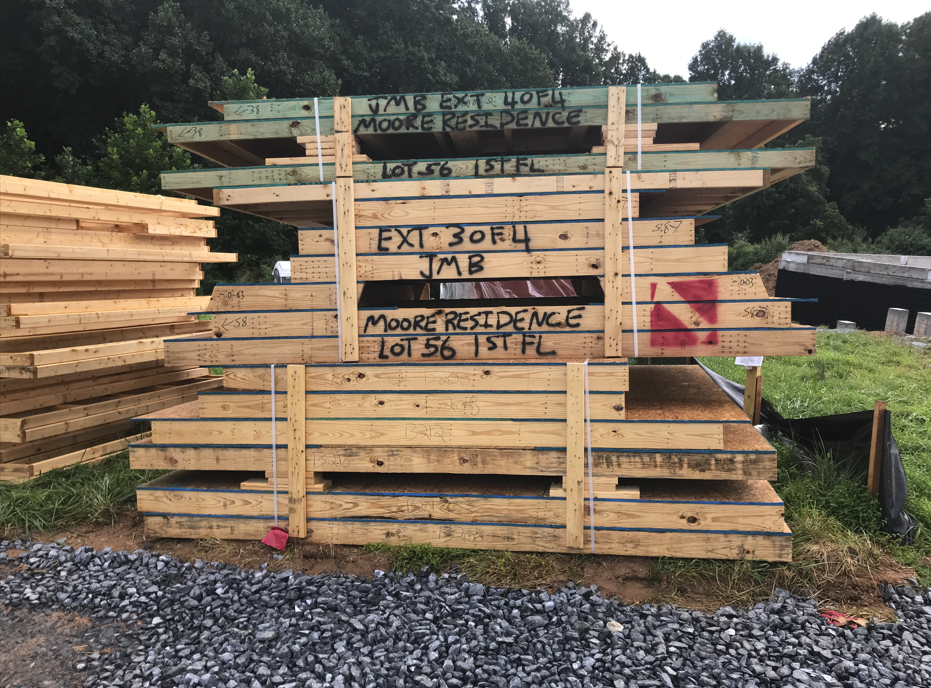
In September 2019, when we were in the process of building our own home, I walked up the rocky, dirt driveway and saw our last name, “Moore,” spray-painted in large black letters on the side of the wooden mountain that would serve as the framing and bones of our house. How would all this lumber be used to form our house? How would the builders know where each piece would be laid?
I stood at the foundation's edge and looked down at the grey hole that would be our home's basement. The large pit seemed solid and whispered of things to come, hinting at the structure it would support.
We visited the house daily, and the framing took shape within a week. Like tiny ants on a big mountain, the men climbed from the rafters, setting each piece of lumber in its designated spot. The framing for the front porch, the garage, the second floor, and the roof all went up in consecutive order. What we had waited for was coming to life before our eyes!
After the foundation of our relationship with God has been built, it is time to build our spiritual walls. The spiritual walls provide structure and stability to our partnership with God. The framework is not wood, but a set of principles that God teaches us to live by. These principles are called Christian doctrine. Understanding Christian doctrine shapes our thoughts, lives, and actions. These framing walls protect the mind and body from spiritual attack. When storms enter our lives, the walls stay secure and tethered to a strong foundation.
We establish our spiritual framework through personal Bible study, prayer to God, obeying his word, and learning from others in our Christian community. We should be in a continuous cycle of growth and wall-building-- learning and teaching. We are teachers of our children and of those around us. Community is so essential in our spiritual growth. External influences in our lives shape how we think and perceive the world. This ultimately affects our choices and our doctrinal understanding of our relationship with God.
The most important aspect of wall building is discerning whether the information we use to build our doctrinal understanding is, in fact, the truth. How do we determine whether biblical advice aligns with the foundation of the gospel and the Bible? Who is your go-to for learning the doctrine of the Bible? Do you regularly listen to a favorite pastor, online church, or Bible app?
We live in an age of information bombardment, conveniently provided in digital form through our personal devices. Within seconds of searching for a topic, we are given a list of suggested solutions to our questions. Many religions speak of morality, prayer, light, and truth. How do we discern what the truth is? How do we know that what we are learning aligns with Christ as the cornerstone and the truths of the Bible?
On his podcast, John Piper discusses the tests God has given in the Bible to help us discern doctrinal validity. The four main tests for evaluating the validity of doctrinal information are the fruit test, the doctrine test, the scripture test, and the gospel test. (Piper)
The first test is the spiritual fruit of a teacher. The Bible uses fruit as a metaphor for a person’s actions. If the teacher is not practicing what they preach, you are unlikely to base your beliefs on their teachings. The second test is the doctrine test: Does the teacher speak against the central concepts of Christianity, like laying another foundation that resembles a works-based salvation? (Piper) Another example is the teaching that deny the deity and the resurrection of Jesus. These are foundational concepts of the Christian faith. In 1 John, he warns that any teacher who denies Jesus Christ as God and man is false. (1 John 4:1-3)
The third test is the scripture test. A teacher is false if they add or subtract information from the canonized Bible to suit their own purposes or mission. The Bible is the standard by which all other doctrine is compared. The fourth test is the gospel test. A teacher or writing is false if it declares any other way to be saved other than by faith in Jesus Christ as Lord. (Piper) Doctrinal accuracy is of utmost importance to building the structure of our faith. If you are not careful, it is easy to be led astray and build a house that will not protect you from the storms of life.
The four doctrinal tests empower us to discern good from false teaching as we evaluate the teachers around us. In essence, all teaching, doctrines, attitudes, and affections must align with Christ and His Word. In most faiths, identity and morality reside within the individual, but in Christianity, they are found in Christ. When we are in Christ, we become a new creation, and everything we build is based on obedience and right living in accordance with the Bible. The challenging aspect is that many religions emphasize morality, prayer, light, and truth. The four doctrinal tests enable us to clearly distinguish between what is true and what is false.
Building the spiritual framework is essential to understanding how we live, act, and think under the saving grace Jesus gave us on the cross. We build our spiritual house framework by reading God’s word, praying, obeying his word, and learning from others in our Christian community. God never intended us to pursue spiritual life and growth independently. We build walls through the teachings we listen to, the church we attend, the small groups we participate in, and the Christian family and friends we interact with. When we build our spiritual foundation on God’s word, our walls will line up to guard and protect our minds and hearts through life’s difficulties. When we align our lives with sound doctrinal truth, spiritual blessing will come from secure walls tethered to our firm foundation.
References
Piper, John. “Four Tests for False Teaching.” Desiring God. Ask Pastor Johns. www.desiringgod.org, https://www.desiringgod.org/interviews/four-tests-for-false-teaching. Accessed 4 Nov. 2025.


Comments